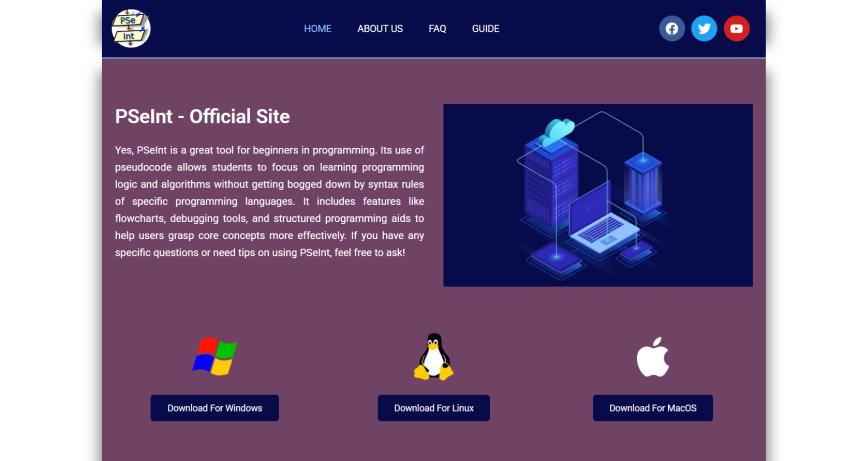
PSeInt, short for “PSeudo Interpreter,” is a powerful educational tool developed with the aim of helping Spanish-speaking students grasp the foundational concepts of algorithm design and structured programming. While many tools are available for beginners entering the world of programming, PSeInt stands out for its simplicity, accessibility, and educational value. It presents pseudocode in a friendly environment and offers features that guide learners step by step through the algorithm creation process. Its design philosophy revolves around minimizing the intimidation factor of programming while reinforcing algorithmic thinking.
Simplified Syntax and Structure
One of the most remarkable features of PSeInt is its highly simplified pseudocode syntax. Traditional programming languages like C++, Java, or Python come with strict syntax rules that can overwhelm beginners. PSeInt avoids this barrier by offering a structure that resembles plain language. This makes it easier for users to focus on understanding logical sequences, loops, conditional structures, and function declarations without worrying about semicolons, curly braces, or indentation issues.
This structure reads almost like a sentence, helping students naturally connect the logic they are implementing with the code they write. As a result, the mental transition from flowcharts or logic diagrams to actual pseudocode becomes far more intuitive.
Tailored for Spanish-Speaking Students
Another unique advantage of PSeInt is its focus on the Spanish language. While most programming tools are in English, PSeInt embraces Spanish syntax and instructions, eliminating language barriers for Spanish-speaking learners. It not only uses Spanish keywords but also allows interface localization. This focus significantly boosts accessibility and confidence among beginners who might struggle to comprehend technical terms in a non-native language.
PSeInt fills a gap in computer science education by providing native-language tools that support the conceptual transition from algorithmic logic to practical programming. This is particularly valuable in Latin America, Spain, and other Spanish-speaking regions where educational institutions often introduce computer science courses using their native language to improve understanding.
Strong Visual Representation and Flow
PSeInt offers a visual, flowchart-like representation of algorithms that complements its text-based pseudocode interface. This dual representation reinforces comprehension by showing both the code and its execution path. When students run a program, they can see how the algorithm flows, which variables are being modified, and which branches are taken.
By observing the flow of execution step-by-step, learners get immediate feedback on their logic. This interactivity builds a solid understanding of how conditional logic, loops, and function calls work in real time. Instead of just writing code and hoping it functions, students can walk through the logic and identify exactly where errors occur or decisions are made.
This level of feedback and visibility is rarely found in more complex programming environments. It helps demystify abstract programming concepts, especially for those who learn best through visual aids and practical engagement.
Error Highlighting and Descriptive Feedback
Beginners are bound to make mistakes as they learn. One of PSeInt’s strengths is how it handles errors. Instead of offering cryptic error messages like many compilers, PSeInt provides clear and friendly feedback that guides the user toward understanding the problem. The system often highlights where the error occurred and explains it in plain terms, such as reminding users that they forgot to end a loop or that a variable was used before being initialized.
This constructive approach to error correction turns mistakes into learning opportunities. Rather than frustrating users or discouraging them, PSeInt’s messaging fosters a more patient and guided learning process. It mirrors the helpful feedback a teacher might give during in-person instruction, which makes it an excellent supplement or replacement for classroom teaching in self-learning contexts.
Step-by-Step Execution and Debugging Tools
To understand the behavior of algorithms, students need more than just theory; they need to see their algorithms in action. PSeInt allows students to execute their pseudocode line-by-line, watching the effects of each command on variables and program flow. This feature is vital for learning the dynamics of code.
The debugger built into PSeInt includes capabilities such as breakpoints, watch variables, and step-over execution. These tools help students experiment and explore different logic paths within their code. By offering the ability to observe the effects of each line in real time, students can better understand where their logic goes wrong and how to correct it.
Learning by doing is one of the most effective strategies for mastering complex skills, and PSeInt’s interactive approach embodies this philosophy. The result is faster learning, better retention, and increased problem-solving capability.
Encouragement of Logical and Algorithmic Thinking
At its core, pseudocode exists to emphasize logic rather than syntax. PSeInt encourages students to think algorithmically, which is the foundation of all good programming. It focuses learners on breaking down problems into steps, considering alternative paths, and creating modular, maintainable solutions.
The interface is designed to emphasize these thinking patterns. Features such as auto-completion of control structures and templates for loops, conditionals, and input/output help structure the user’s thought process. Rather than getting stuck on how to express logic in code, students spend more time thinking critically about the steps needed to solve a problem.
This approach helps develop computational thinking skills that transfer easily to real-world programming languages later on. Once students are comfortable creating structured solutions in PSeInt, transitioning to more formal languages like Python or C++ becomes much smoother.
Support for Algorithm-Based Education
In educational environments, especially during introductory computer science courses, the focus is usually on building foundational logic before introducing the complexity of full programming languages. PSeInt fits perfectly into this educational trajectory.
Many instructors use PSeInt to teach the basics of algorithm design, especially before introducing languages like Java or C#. PSeInt provides a controlled environment where students can make mistakes, get real-time feedback, and master the basic building blocks of algorithms—loops, conditionals, data input/output, and simple functions.
This preparatory phase is crucial. Students who begin with PSeInt are more likely to succeed when moving on to actual code because they already understand how to approach problem-solving through logical steps. Teachers also benefit, as PSeInt provides a shared language and tool for explaining key ideas and evaluating student progress.
Low Hardware Requirements and Offline Availability
PSeInt is lightweight, which makes it accessible on a wide range of hardware. In regions with limited access to high-performance computers or internet connections, this is a critical feature. The software runs well on older machines and does not require internet access for installation or daily use.
Offline availability is especially beneficial in classrooms where internet connectivity is unreliable. Students can work on their assignments, practice algorithms, and debug problems entirely offline. This level of flexibility ensures that technical limitations or infrastructure gaps don’t disrupt learning.
Moreover, PSeInt is free and open-source, which lowers barriers even further. Schools, teachers, and students can adopt it without worrying about licensing fees or subscriptions. This accessibility plays a huge role in promoting digital literacy and programming education globally.
Community and Documentation
A helpful user community surrounds PSeInt, providing forums, tutorials, example problems, and video walkthroughs. Though it is primarily aimed at Spanish-speaking users, some resources are available in other languages as well. This community support helps learners who need clarification or want to explore more complex uses of the software.
Additionally, PSeInt comes with built-in documentation and a user manual that guides new users through its interface and features. These materials are written in approachable language and often include screenshots and examples. The result is a gentle learning curve supported by rich educational resources.
Bridge to Real Programming Languages
Although PSeInt is a pseudocode interpreter, it serves as a stepping stone to real programming. Once students have mastered algorithm design using PSeInt, they are better equipped to handle real programming syntax and semantics. Because the core logic—variables, loops, conditionals, and functions—remains the same, learners find it easier to transition to languages such as Python, Java, or JavaScript.
In fact, many educators recommend using PSeInt as a first step in curriculum design. It lays the groundwork by teaching students how to think like programmers before exposing them to the syntax rules of actual languages. This strategy has proven effective in improving long-term retention and problem-solving ability.
Encouragement of Creativity and Independent Learning
Finally, PSeInt fosters creativity. Since pseudocode is flexible and non-restrictive, students are encouraged to experiment, try different solutions, and build algorithms of their own design. This creative freedom promotes a deeper understanding of programming logic and cultivates a mindset geared toward innovation and problem-solving.
The ease of use and low risk of making catastrophic mistakes (as in compiled languages) encourages students to explore without fear. This independence leads to increased confidence and engagement with programming tasks.
Conclusion
PSeInt is an ideal platform for learning pseudocode and developing algorithmic thinking. Its approachable syntax, visual representation of flow, real-time feedback, and emphasis on logic over language make it an exceptional educational tool. Particularly suited for Spanish-speaking learners, it breaks down barriers to entry and provides a nurturing environment for mastering the essentials of programming logic.