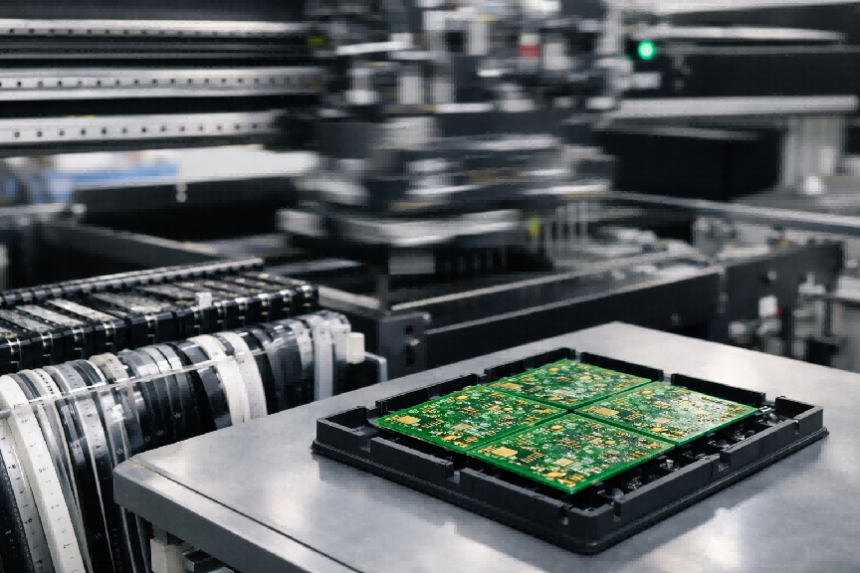
When deadlines are tight and your design team needs to test a new idea quickly, a fast turnaround PCB prototype can make all the difference. Instead of waiting a week or more for boards, engineers now expect fully fabricated and assembled prototypes within just a few days — sometimes in 24 hours.
This article explains what “fast turnaround” really means, how you can prepare your files for speed, and why choosing the right one-stop partner ensures both speed and quality.
What Is a Fast Turnaround PCB Prototype?
A fast turnaround PCB prototype is a printed circuit board that’s fabricated and optionally assembled in as little as one to three working days. It is designed for engineers who need to validate circuits during early product stages, such as proof-of-concept, EVT, or design validation.
While traditional fabrication takes 5–10 working days, modern manufacturers like FastTurn PCB now deliver small-batch prototypes much faster — even within 24 hours for standard two-layer boards, thanks to their streamlined process, including online quoting, DFM file checks, fabrication, assembly, testing, and delivery.
Lead-Time Tiers You Can Actually Hit
Quick-turn fabrication usually falls into four time brackets:
- Same-day / 24 hours – for simple 1–2 layer designs with standard FR-4 material.
- 48–72 hours – ideal for small runs of multilayer prototypes.
- 5–7 days – for more complex HDI or impedance-controlled boards.
- 10–15 days – for production quantities or custom stack-ups.
To achieve a 24–72-hour turnaround, you must use standard materials and finishes such as HASL or ENIG, provide DFM-ready Gerber files, and confirm your design fits within the manufacturer’s standard capability window. Learn how to scope a fast turnaround pcb prototype that truly ships on time by aligning your design rules early.
What Really Drives Speed (and Cost)
1. Design Rules
Trace width, spacing, via sizes, blind or buried vias, and impedance control all impact turnaround time. Simpler designs with standard geometries allow the factory to run them on established process lines. Complex HDI structures or thick copper layers add extra lamination and inspection steps.
2. Materials and Stack-Ups
Choosing standard FR-4 or high-Tg material from stock is key for fast turnaround. Exotic laminates like Rogers or polyimide often require special prepreg, which can lead to sourcing delays. Stick with common copper weights and standard dielectric thickness to stay in the 24–72-hour range.
3. Surface Finish and Color
Common finishes — HASL, ENIG, ENEPIG, or OSP — can usually be processed immediately. Special colours or finishes may extend cycle time. If speed matters, use the most common green solder mask and white silkscreen.
4. Testing and Inspection
Electrical testing, AOI, X-ray, or micro-sectioning help guarantee reliability, but can add hours to your timeline. The best suppliers balance speed with quality using automated inspection and flying-probe systems.
DFM Checklist for First-Pass Success
Preparing manufacturable data is the fastest way to avoid re-spins. Before submitting your order:
- Include Gerber or ODB++ files, drill files, layer stack-up, and impedance requirements.
- For assembly, attach the BOM (Excel format), the Pick-and-Place/XY file, and the assembly drawings.
- Use clear polarity and reference marks for each component.
- Verify that your design meets your vendor’s minimum trace/space requirements, as well as the via size (e.g., 3/3 mil and 0.1 mm via).
- Add panel frame, fiducials, and tooling holes if your design requires testing or depanelization.
- Run an online DFM check to ensure there are no missing apertures, copper slivers, or outline mismatches.
FastTurn PCB provides free engineering review, quick quoting, and one-on-one technical support to catch potential DFM issues before production begins. That saves precious hours when every minute counts.
Why One-Stop Turnkey Beats “DIY + Broker” for Speed
Many engineers try to order bare boards from one supplier and ship them to another for assembly. While this looks flexible, it often adds 3–5 days of logistics and confusion about BOM, parts, or stencil data. A single partner who handles fabrication, sourcing, assembly, and testing under one roof eliminates those delays.
FastTurn PCB offers full, partial, or kitted turnkey services. They can quote within 6 hours, start assembly immediately upon parts arrival, and complete full SMT/THT builds in 8–72 hours. With in-house Samsung and Yamaha SMT lines, nitrogen reflow ovens, and AOI/X-ray inspection, everything happens faster and with tighter quality control.
Quality and Reliability Still Come First
Speed should never mean cutting corners. A reliable, quick-turn manufacturer maintains strong quality systems and certifications. FastTurn PCB is ISO 9001 and UL certified, and all boards meet IPC-A-600 and IPC-A-610 Class 2/3 standards. Every product passes AOI, X-ray, ICT, or functional testing as required.
Their team builds up to 50-layer PCBs, supports ±5% impedance tolerance, and handles fine-pitch parts such as 01005 resistors and 0.3 mm BGAs. That means even complex prototypes can be built fast — and still meet production-level quality.
Quick FAQ
How fast is “fast turnaround”?
Bare boards can be completed in 24 hours, with standard quick-turn delivery in 48–72 hours, depending on complexity.
Can you start from one piece?
Yes, FastTurn PCB supports 1 piece and scales to small- and medium-volume runs.
Do you handle sourcing and testing?
Yes — they offer full/partial/kitted sourcing, AOI, X-ray, ICT, and functional testing.
Which industries do you serve?
Medical, industrial control, communication, semiconductor, and consumer electronics worldwide.
Call-to-Action
A fast prototype can turn an idea into reality — and a working board into your next big launch. Upload your Gerber files and BOM today for an instant quote, quick DFM review, and 24–72-hour turnaround.Ready to move from concept to board? Partner with FastTurn PCB for reliable one-stop fabrication and assembly that keeps your project on schedule.