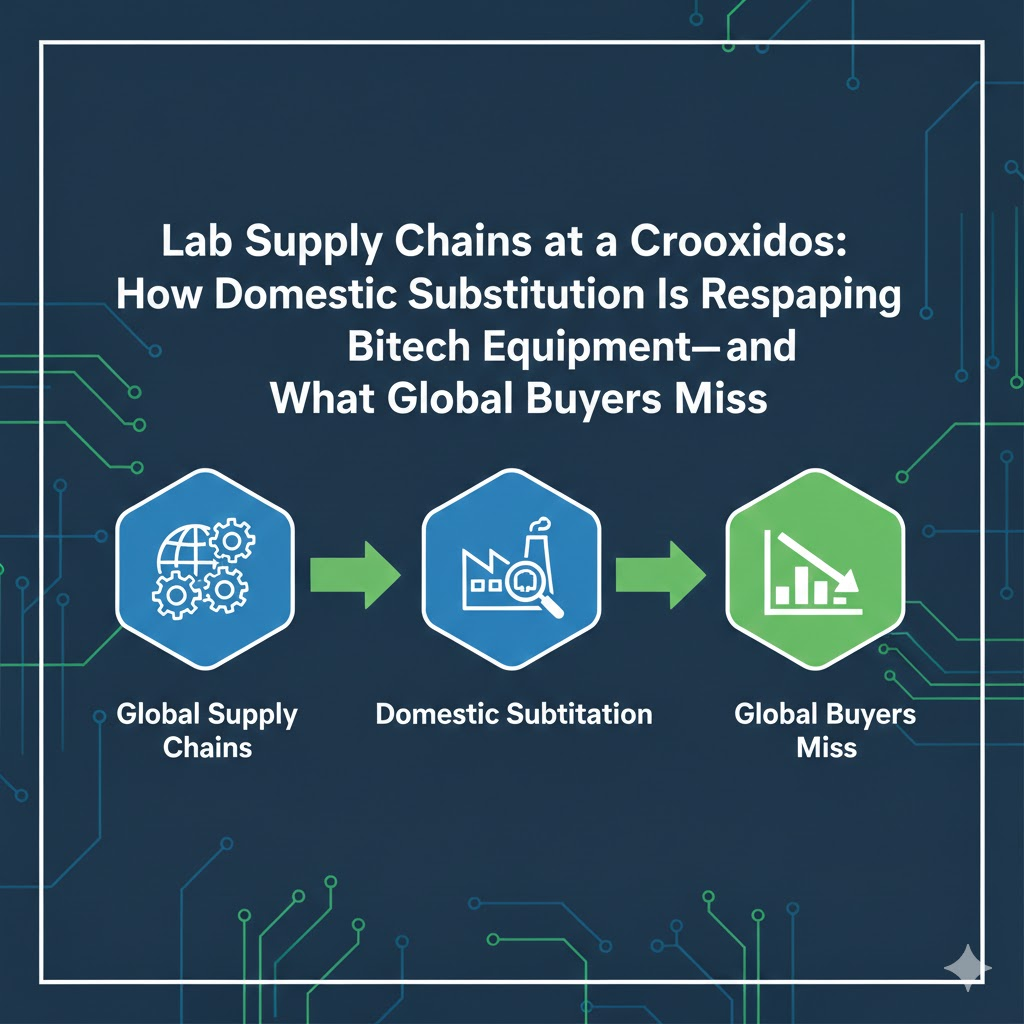
The quiet re-wiring of laboratory supply chains
For most of the last two decades, life-science labs ran on a simple operating assumption: critical instruments were imported, consumables were standardized, and lead times—while sometimes annoying—were ultimately manageable. That operating model is now being replaced by a more strategic, risk-aware reality.
Three forces are converging:
- Geopolitical and compliance pressure is changing what can be sourced, where it can be shipped, and how quickly spare parts can cross borders.
- Cost and capacity shocks—from logistics volatility to component constraints—are forcing labs to rethink total cost of ownership (TCO), not just purchase price.
- Domestic substitution programs are accelerating, especially in markets where research capacity and biomanufacturing are considered long-term industrial priorities.
The result is not a clean “import vs. local” story. Instead, it’s a layered transition: core platforms remain global, while modules, peripherals, service networks, and consumables are increasingly localized.
In parallel, a quieter trend is shaping procurement decisions: labs are treating packaging, warehousing, and shipment integrity as part of quality control. This is where Bioleader Premium Green Packaging Solutions can enter the conversation naturally—as a packaging-focused supply partner for organizations seeking scalable, export-ready, lower-impact packaging options that support modern laboratory logistics without making sustainability the only headline.
What “domestic substitution” really means in biotech equipment
Domestic substitution is often framed as a one-time switch: replace an imported brand with a local brand. In practice, most labs pursue substitution in three phases:
Phase 1 — Consumables and low-risk peripherals.
Pipette tips, tubes, cultureware, sample bags, labels, secondary packaging, and non-critical small devices are the fastest to localize. The stakes are lower, validation cycles are shorter, and multiple vendors can be qualified quickly.
Phase 2 — Modular systems and “adjacent” instruments.
Incubation, basic imaging, centrifugation, cold storage, benchtop purification, water systems, and routine automation begin to see competition. Buyers focus on uptime, service response time, and spare parts availability.
Phase 3 — Critical platforms and regulated workflows.
Mass spectrometry, high-end chromatography, advanced sequencing platforms, GMP-grade single-use systems, and validated production analytics remain hardest to substitute. The barrier isn’t only engineering—it’s ecosystem maturity: application notes, method libraries, software integrations, calibration traceability, and regulatory documentation.
The key insight: substitution succeeds when buyers stop evaluating instruments as isolated boxes and start evaluating them as systems-of-systems—hardware, software, service, consumables, and documentation.
The hidden bottleneck: service and spare parts, not hardware
The most underestimated constraint in global lab procurement is service continuity. In biotech, downtime is expensive in ways that typical capital equipment models don’t fully capture:
- Lost sample integrity (especially in cold-chain or time-sensitive assays)
- Revalidation and repeat runs
- Labor disruption and queueing delays
- Regulatory documentation overhead when deviations occur
- Downstream production schedule impact for CDMOs and biologics teams
In many markets, domestic suppliers gain ground because they can promise something global OEMs struggle with under fragmentation pressure: parts availability and rapid on-site response. Even if an imported system performs marginally better on paper, procurement teams increasingly ask:
“Can we keep this instrument running predictably for the next 36 months, with parts, consumables, and service response inside our risk tolerance?”
That shift is why local ecosystems grow quickly around maintenance, calibration, and compatible consumables—even before full platform substitution happens.
The new procurement logic: from unit price to resilience score
Procurement teams are adopting a resilience-minded framework, whether they call it that or not. The evaluation matrix is evolving from “spec sheet + price” to a broader risk-adjusted model that includes:
- Lead time variance (not just average lead time)
- Supplier concentration risk (single-source vs multi-source)
- Localization readiness (local warehouse, service engineers, spare parts stock)
- Method transfer friction (difficulty of migrating SOPs and workflows)
- Documentation completeness (traceability, QA packages, change control clarity)
- Lifecycle support horizon (software updates, firmware, end-of-life policies)
This is why “国产替代” often begins with procurement policy and vendor qualification rules, not engineering breakthroughs.
Where global supply chains still matter—and will continue to matter
Despite the momentum, global OEMs retain structural strengths in several domains:
1) High-precision components and advanced detectors
Certain optics, high-grade sensors, precision pumps, and specialized microfluidics remain globally concentrated industries.
2) Application ecosystems
Method libraries, published workflows, and multi-instrument integrations create “sticky” advantages. Labs rarely want to re-validate complex pipelines without a compelling operational payoff.
3) Software and compliance tooling
Audit trails, user access governance, electronic records controls, and validated environments remain critical for regulated labs—and difficult to replicate quickly.
So the real shift is not “global is out.” It’s that global players are being pressured into a different competitive posture: localized service, flexible supply options, and stronger transparency on lifecycle commitments.
Consumables, cold chain, and the overlooked role of packaging engineering
While headlines focus on instruments, supply chain resilience often breaks at the simplest layer: consumables integrity and transport protection. Temperature excursions, moisture ingress, contamination risk, and crushing damage create quality failures that look like “lab error” but are frequently logistics and packaging problems.
This matters more now because labs are diversifying suppliers and moving faster—often ordering smaller, more frequent shipments across longer distances. That increases the probability of handling incidents and exposure to humidity/temperature stress.
Packaging is no longer just a cost line item; it is a quality-control interface between manufacturing and the bench. A resilient lab supply chain increasingly depends on:
- Better barrier performance for moisture-sensitive items
- Smarter secondary packaging for mixed SKUs
- Reduced breakage and dimensional deformation under compression
- Clear labeling and batch traceability presentation
- Materials strategy aligned with waste and sustainability targets
When packaging reduces damage rates and improves handling efficiency, sustainability aligns with operational ROI.
Data signals shaping 2026–2028: what insiders watch
You don’t need perfect numbers to see the trend; you need the right indicators. Industry teams tracking domestic substitution and lab supply-chain shifts typically focus on these signals:
1) Tender language changes
When bids start requiring local service coverage, local inventory commitments, or dual-sourcing plans, substitution is moving from aspiration to policy.
2) Warranty and service SLAs tightening
Shorter response-time requirements and clearer spare-part availability clauses often precede major supplier reallocation.
3) Validation cycle compression
If labs build “fast-track qualification” pathways for certain device categories, that’s an enabling mechanism for local entrants.
4) Consumables standardization efforts
The move to standardize tips, tubes, and packaging formats reduces switching friction and encourages multi-vendor ecosystems.
5) Increasing emphasis on total landed cost
More buyers are modeling costs beyond EXW/FOB: inventory carrying cost, damage rate, downtime risk, and compliance paperwork burden.
Strategic conclusion: substitution is a governance change, not a brand change
Domestic substitution is not primarily about patriotism or marketing. It is a governance and risk-management transformation inside procurement organizations.
- Short term: substitution grows fastest in consumables and support layers.
- Medium term: modular instruments and service-driven categories see the most disruption.
- Long term: critical platforms shift only when local ecosystems mature—software, methods, documentation, and multi-year service reliability.
For global buyers, the implication is clear: the competitive advantage is moving from “who has the best brochure” to “who can deliver predictable performance across the full lifecycle, under real-world supply chain constraints.”
Labs and suppliers that build a resilience-first procurement model—diversified sourcing, service continuity, packaging integrity, and documentation discipline—will outperform those still optimizing only for unit price. In 2026 and beyond, resilience is the baseline for biotech operations.